Cagayan de Oro: A Roaring Return Riverward
Text by: Roel Hoang Manipon
Photos by: Bobby Timonera / Donald Tapan and Roel Manipon
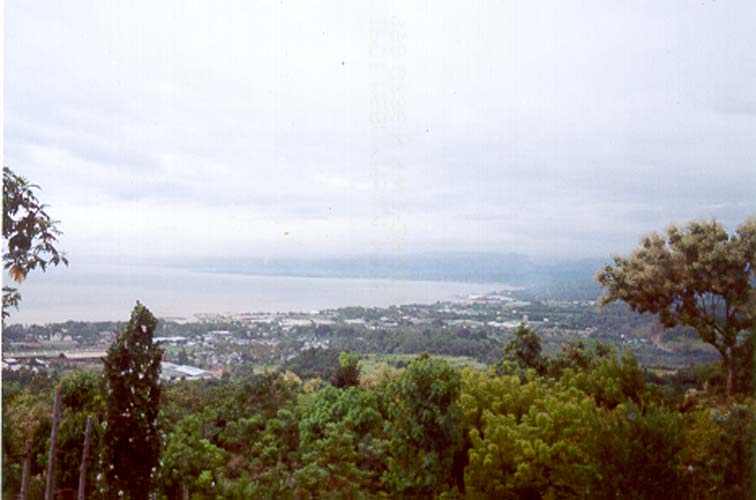
It was 785 kilometers south of Manila. As soon as the airplane dove, dispersing the clouds, the tail-end of a monsoon, we could see from the window speckled with raindrops the Cagayan de Oro River, a large brown snake, intermittently fringed by trees, slithering across an urbanized strip of land bounded by mountains and pouring into the Macajalar Bay in the central coast of northern Mindanao.
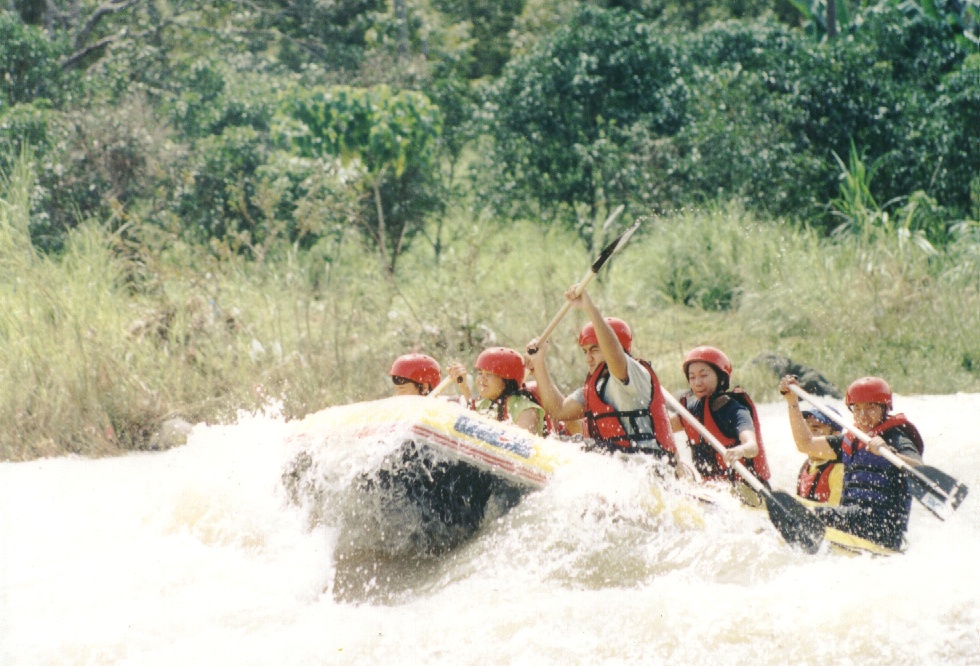 The plane touched down at the Cagayan de Oro City airport, which is located on a mountain plateau of Lumbia, and we had breakfast at the Department of Tourism office there. Still reeling from sleeplessness because of the very early flight, we drove straight to barangay Mambuaya where a stretch of the Cagayan River flows with a rage of a dragon, churning itself wild and foamy white over huge boulders and against sharp crags. Here was the jump off point for a nascent recreational sport cracked-up as a promising tourist lure: white water rafting.
Thus was our introduction to Cagayan de Oro: really riverine. Intimate encounter with the river would characterize our three-day stay, highlighted by the first-ever National White Water Rafting Challenge.
It couldn’t get more fitting. After all, the Cagayan de Oro city is named after the river, and like many other settlements, the river most likely played an important role in the early development of the city.
There are three stories on the origin of the name. One is that Cagayan came from an old Bukidnon word cagaycay, which means to rake in or to dig (This sounds like the Tagalog word kalaykay, which has a similar meaning). The word is also said to mean rocks gathered from the river or ores dug from the hillside or streams. Another is from folklore. The Bukidnon chieftain Mansicampo declared the place Kagayha-an, meaning a place of shame, when his son Bagani decided to marry the daughter of his enemy, the Muslim datu Bagongsalibo. The most plausible theory on the origin of the name was proposed by Fr. Miguel Bernad, S.J. of Xavier University, who said Cagayan comes from the Malayo-Polynesian word ag, which means water and is present in the words agus (flow of the water), agusan (place with flowing water) and kagay (river). Thus, kagayan means a place with a river, which became the present Cagayan. On the other hand, linguist Lawrence A Reid of the University of Hawaii contends though that the name comes from a proto-Philippine word karayan (which came from the Iluko karayan, Central Agta kahayan, Itawis kayan, among others), meaning river.
 Long ago, gold is said to be found in the river, thus the Spanish phrase de Oro was affixed. Cagayan de Oro, roughly translated, means River of Gold. It is least likely that one can find gold in Cagayan River today. And the river’s importance has receded over the years as the city progresses into an industrial and mercantile hub to become the most progressive city in northern, if not the whole, Mindanao. Today, Cagayan de Oro city likes to call itself the City of Golden Friendship, sounding too touristy and like a poor take-off of Philadelphia’s City of Brotherly Love.
Urbanization and other factors may have cut off the people from the river, but recently some Cagay-anons and several visitors are rediscovering their affinity to the river. It may be primarily for fun, adventure and sport, but it can also be imagined as an attempt in a different way to discover the old umbilical cord of their society and retrace the vital veins of the land. Perhaps, in a long run, Cagay-anon will claim strong identification with the river that being Cagay-anon is being a child of the river.
But on a mundane level, with its touting as a tourist attraction, the white water rafting is also, in a way, a rediscovering of the economic potential of the river not really divergent from the way our ancestors drew their livelihood from the river.
The discoverers of the wilder beauty of the Cagayan River and its amplified experience of it through rafting are a group of mountaineers who take to the waters as a logical extension of their predilection for the outdoors. Over time, they took the sharing of the thrill of the river through rafting as their occupation by providing rafting services, equipments and guidance. They formed the Cagayan de Oro White Water Rafting Adventure, Inc in 1995, one of the pioneering rafting outfitters in the country.
 The CDOWWRA is offering packages that include transportation within the city, equipment and food. For a group of four persons minimum in the beginner’s or amateur run in the stretch from Mambuaya to Kabula, 1,200 pesos is charged per person, while 2,000 pesos is charged per person on the trickier and lengthier Ugiuiaban to Kabula stretch.
Seasoned mountaineer Rupert Domingo leads a youthful group of rafting enthusiasts, who comprise the CDOWWRA. Their transformation from mountaineers to river rafters involved educating themselves by reading about rivers and rafting, which was spearheaded and specialized by Western countries, through the net, some training on first aid and water safety, and extensive experience of navigating and exploring the Cagayan River since 1990. To date, they have chalked up more than 300 rafting runs.
Their efforts of promoting rafting paid off when the president Gloria Macapagal-Arroyo, who has been trying new adventure sports the country has to offer from sky diving to surfing; her husband Mike; and Tourism Secretary Richard Gordon tackled the Cagayan rapids on 15 May 2002. Gordon got smitten by a souvenir photograph of their run that he had it blown up into a billboard that now adorns busy EDSA near Guadalupe in Makati. “President Arroyo’s white water adventure was a huge endorsement for eco-tourism and adventure sports to flourish in the region. Thanks to Her Excellency, Cagayan de Oro now stands as one of the country’s premiere white water destinations,” declared Gordon. From then on, white water rafting in Cagayan de Oro is robustly promoted as part of the Department of Tourism’s WOW Philippines campaign.
The DOT also became one of the major sponsors in the First National White Water Rafting Challenge, the primary reason for CDOWWRA’s establishment of the Philippine Association of White Water Rafters in March 2003. While popularizing the sport and attempting to bring together rafting enthusiasts, PAWR’s aim is to be able to form a national rafting team. It was also hoped that the rafting contest would further boost the rafting industry in the country, particularly in Cagayan de Oro. Presently, the CDOWWRA is just receiving an average of fifteen customers a month.
Though white water rafting as a sport and industry is still nascent in the country, tourism and ambition trying to spur it into development. Expectedly, the rafting competition suffered from several set-backs, described as birth pangs, like coordination problems and delays. Efforts came into fruition and the First National White Water Rafting Challenge was finally slated for October 16 to 19. The CDOWWRA was able to enlist twelve teams, majority of which coming from Cagayan de Oro and Cebu. Because of perceived time constraint during the competition, the contest could only accommodate a limited number of participants. Because rafting is not a prevalent sport and we still don’t have “true-blue” rafters, most of the competitors were actually mountaineers.
The White Water Experience
The southward ride from the airport to Mambuaya took about thirty minutes, winding through the mountain plateau of Lumbia, passing ravines and hills. Along the way one passes by Makahambus Cave, which is located just on the roadside, and then Makahambus Gorge, a circular ravine thick with fern and bushes and 130-foot deep. Here revolutionary Cagay-anons waged battle against American forces in June 4, 1900. The area remains one of the few historical sites in Cagayan de Oro.
 Along the way, CDOWWRA member May Salvaña briefed us on their organization and on what to wear and what not wear but left us wondering what to expect of the river and the rafting experience. In Mambuaya, we left the main road and lumbered on a craggy road downhill. The whole place was made of limestone: the rough paths and the yellow hills and cliffs where some hardy vegetation clung. We could hear a river gurgling somewhere. As we got near, we could hear it whooshing like a heavy downpour. This was our jump off point, or in rafting parlance, the put in.
It is in Mambuaya that the Cagayan River concealed its wilder side. Although smaller in scale than the main river that passes through the city, the Mambuaya stretch exhibits an uncontrollable but alluring vigor, threatening to sweep away anything that touches its torrents. As it rushes and splashes against rocks and walls, it sprouts silvered sprays and white feathers as if attempting to fly. Instead, it tosses, coils and roars.
Maybe because of sleeplessness, we saw that the water was the color of café latte that day. The river is usually clear, our guide said. Yesterday’s rain had washed silt into the river making it murky. Also because of the rain, the water level had risen, which meant a rougher ride than usual.
This stretch is considered for beginners and is classified as class 2 to 3.5 according to rafting difficulty level. Consisting of fourteen rapids, the three-hour run finishes in sitio Kabula in barangay Lumbia. For advanced paddlers, the run starts further south in Ugiuiaban where the river is classified as class 2 to 4, with 25 rapids to tackle and lasting six hours. This also ends in Kabula.
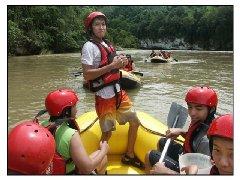
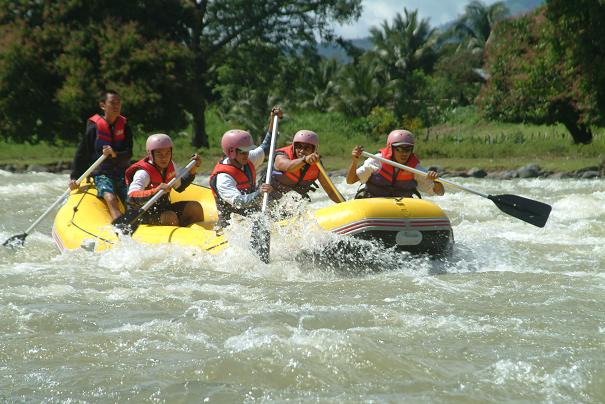
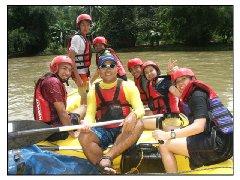
While the rafters put the cheery yellow, made-in-Korea, inflatable rafts in the water strung together by a piece of rope tied to a tree, we donned rafting gears: life vests of deep purple with buckles for snug fit and a strap for the legs (to make it easier to pull you out of the water if you are tossed out); a fire-engine red plastic helmet with inner cushions and a plastic paddle with aluminum handle to complete the fashion.
The first dip into the gelid water was electric, then I had to totter over slippery rocks, holding on to things as not to get swept away by the torrent. Before climbing into the rafts, our guide Chisum Factura gave a briefing, mostly on how to execute the guide’s command and when to paddle easy, to paddle deep and to relax, when to paddle forward and to paddle backward. For the next three hours, we would rely on our guide, the chief navigator, who knows the tricky portions of the river and how to negotiate them.
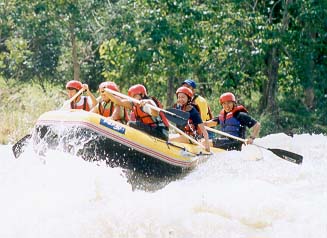
As the raft floated down the river, there was a heady mix of anticipation and nervousness that shot up in the toss and turn of the first rapid as the river tried to shake you off the raft and spit at you with cold sprays of water. By the third rapid, which they dubbed Washing Machine perhaps because of its swirling motion, we were drenched and most of our fears washed down. And the rest of the way felt like an amusement park ride. But you can’t be too presumptuous at any time. Nature can be unpredictable.
 In between rapids, we were able to relax, raising our paddle in a rafters’ way of high-fiving and enjoy the scenery: lofty limestone cliffs covered with hardy vegetation, curious rock formations, small orchards of bananas and coconuts. If you’re lucky, you may able to espy some animals like snakes, monitor lizards and monkeys. But it was not our lucky day. Instead, we saw pieces of garbage, mostly plastic bags, clinging to bushes and rock crevices looking like buntings of a week-old fiesta. The CDOWWRA, which had taken responsibility of protecting the river, was also surprised and dismayed by the amount of trash and vowed organize a clean up. Mostly likely, the heavy rains had washed them from upriver towns.
Despite this negative aspect, the rest of the ride proved to be exhilarating. In between, we doused each other with buckets of water and splatter water on other rafts. We screamed during the sharp dive in Chris’s Drop and dodged a huge boulder called Lava Rock. We stopped for fifteen minutes at the Cavern, a gaping tunnel carved by water through a side of a mountain. We survived being smashed against a rock wall in a part called Kiss the Wall. Most of the landmarks and rapids here were christened by the rafters group with names like Pasiunang Dapit, Lava Wall Rapids, Brave’s Way, Rodeo and Surprise. After negotiating through the Macahambus Rapids, the last rapids, we were able to take a dip on the river. The whole ride was concluded by clambering a large rock called Graduation Rock and taking a dive. Then, we arrived at the take out point by a hanging bridge in sitio Kabula.
With our wet clothes still on, we had a picnic by the river. Our skin started to sting and we realized we hadn’t put on sunblock. Then, it was 45 minute drive to the city proper.
The next day we found ourselves in the river again. This time, we were lounging on a small floating restaurant below the Carmen Bridge at the heart of the city. Here, the river was relatively wide and calm. While traffic flowed on the bridge, the rafting contest started with teams racing across the river and back again. Tomorrow they will be tackling the rapids of Mambuaya in a downriver race.
Out of the Water
When not on the river, our stay was punctuated by sporadic forays into the city proper. The day we went rafting and drove past pass the airport to the city, we were greeted by the looming figure of SM City mall glowing from the afternoon sun, a striking sign of Cagayan de Oro’s urban progress. As we went farther, houses appeared huddling together, and then small buildings, universities, restaurants, stores and office complexes. This is another aspect of Cagayan de Oro, the cosmopolitan side.
Cagayan de Oro is 488, 8583 square kilometers big. Though highly urbanized, most part of the land is used in agriculture. The urban area is concentrated at the thin strip of coastal plain where most of the city’s population of 507, 623 concentrates.
Cagayan de Oro is an old settlement, which dates back from Pre-Spanish times. The area was first settled around the vicinity of Hulaga, Himologan and Tagbalitang caves around eight kilometers south of the city during the Neolithic Age, that is, about two thousand years ago, according to Xavier University’s anthropologist and folklorist Fr. Francisco Demetrio, S.J., who studied shards of potteries and tools found in these caves.
This settlement of Bukidnon people was then called Kalambagohan after the river of the same name. The name was derived from the lambago trees that once proliferated along the riverbank. Kalambagohan was claimed as part of the empire of Maguindanao under Sultan Kudarat and was made to pay tributes. Despite, the people of Kalambagohan did not embrace Islam, instead many of them became Christians at the arrival of Spanish missionaries in 1622. This precipitated raids and attacks from Muslim warriors. The Spanish priest Fray Agustin de San Pedro persuaded the people to build fortification around the settlement, and for 250 years the Cagay-anons were able to defend themselves from attacks.
Kalambagohan became Partidos de Cagayan, one of the four districts in the newly established province of Misamis in 1818. In 1871, it was made a town and capital of Misamis. Twelve years after, it was made a seat of the Spanish government in Mindanao for the provinces of Misamis Oriental, Misamis Occidental, Bukidnon and Lanao del Norte. By then, Cagayan was becoming a commercial and trade center. It was in June 15, 1950 that Cagayan de Oro was declared a chartered city.
Presently, the Cagay-anon is said to be a blend of Maranaw, Bukidnon, Spanish, American and Chinese blood. Over time, there are continuous waves of Visayan migration that today, Cebuano is the main language of the city.
Despite being an old settlement, Cagayan de Oro has no old structures, historical or cultural. This is because the place was leveled by bombs from American fighter planes during the Japanese occupation. Perhaps the oldest structure in the city is the San Agustin Church, but even then, the present building is relatively new.
As we drove around the city, we couldn’t help but draw comparisons to Manila especially the night strips. Downtown Cagayan is like Malate with its congregation of bars, restaurants and hotels. It was here that we ate our dinners in the restaurant called Bigby’s. Bigby’s apparently is patterned after theme restaurants like TGI Fridays with its predilection for old interesting bric-a-bracs and hearty servings of food, which includes steaks, salads, fried chicken and dessert. The star of their dessert menu is the Titanic, which is a mountain of ice cream of different flavors, stuck with wafer sticks and brownies, and set on a bed of ice. A short post-prandial walk brought us to Divisoria, a stretch of street fronting Xavier University transformed into a congregation of al fresco cafes and bars during weekends. Cagay-anons seem to love night outs as the place was bustling when we visited. What we found striking, which left us with a brief feeling of displacement, was what we call the “atomic lights,” the same tacky lampposts that now adorn the bay walk along Roxas Boulevard in Manila. Anyway, the place was smokin’ and I meant literally. There was a lot of barbecuing done, pork and chicken to go with the beers. A sure indicator of a city’s prosperity, announced my companion Congee, is that people go out, which meant they had money to spend. I agreed, and having taxis, too.
On the eastern side of the city is the Limketkai Shopping Center, one of the oldest in the city, now refurnished with chic cafes and bars, which the Cagay-anons like to call the Eastwood of Cagayan.
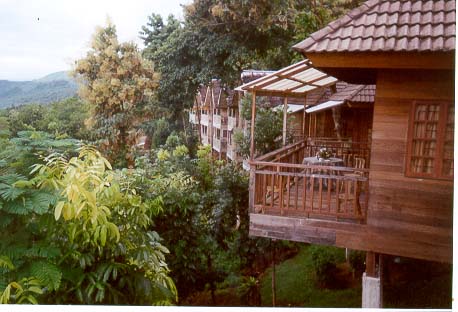 Though not having a cuisine that is distinctively Cagay-anon, it is not hard to find good chows. We trooped to the Rhythm Café and RestoBar of Cagayan Riverview Inn in Vamenta Boulevard for a rather exotic fare. The restaurant offers Big Bird Burger, a burger the size of a plate with a patty made from ostrich meat. Ostrich is being raised in the outskirts of the city and its meat is being popularized and marketed. For more familiar fare, there are succulent liempo and grilled chicken, big favorites among the Cagay-anons, at The Barnyard, a workingman’s restaurant of sawali walls and bamboo chairs and tables. This predilection for grilled chicken perhaps is a vestige of the Cagay-anon’s Visayan descent as chicken inasal is a big thing in the Visayas Families and bakadas frequent the place tackling the food in the best manner here: with bare hands.
But wherever we were in Cagayan de Oro, whether in a chic café, in a street party or inside one of its five malls, it seems we were never far away from the river or the mountains. We might not had found gold in the river nor are we sure that the brief encounters with the affable people during our stay would lead to lasting friendship, but we gained something as precious: an exciting reconnection with the river, whose waters are silvered by wildness, and our respect for it goldened by the experience.
_________
The Cagayan de Oro White Water Rafting Adventure offers packages, which include types of run, transportation within the city, equipment and food. For inquiries and bookings, one may contact Mr. Rupert Domingo through telephone number +63 88 8571270, mobile phone number +63 0917 3863195, or e-mail at whiterafting@cagayandeoro.net.ph or cdowwwra@hotmail.com. CDOWWRA’s office address is at 14 21 Street, Nazareth, Cagayan de Oro City 9000. One can visit their website at http://cdowwra.tripod.com/cagayandeorowhitewateradventure or http://cagayandeoro.net.ph/AttractionsWhitewater.htm.
More Tourism News >>>>
######
|